

Here at True Investigator, we pride ourselves on knowing a thing or two about the fearsome fishes that stalk our planet’s oceans. We’ve talked about the unique predator that is the Hammerhead Shark, as well as its larger, more popular cousin, the Great White. But today, we shift focus to a smaller, but no less ferocious member of the shark family, the Thresher shark.
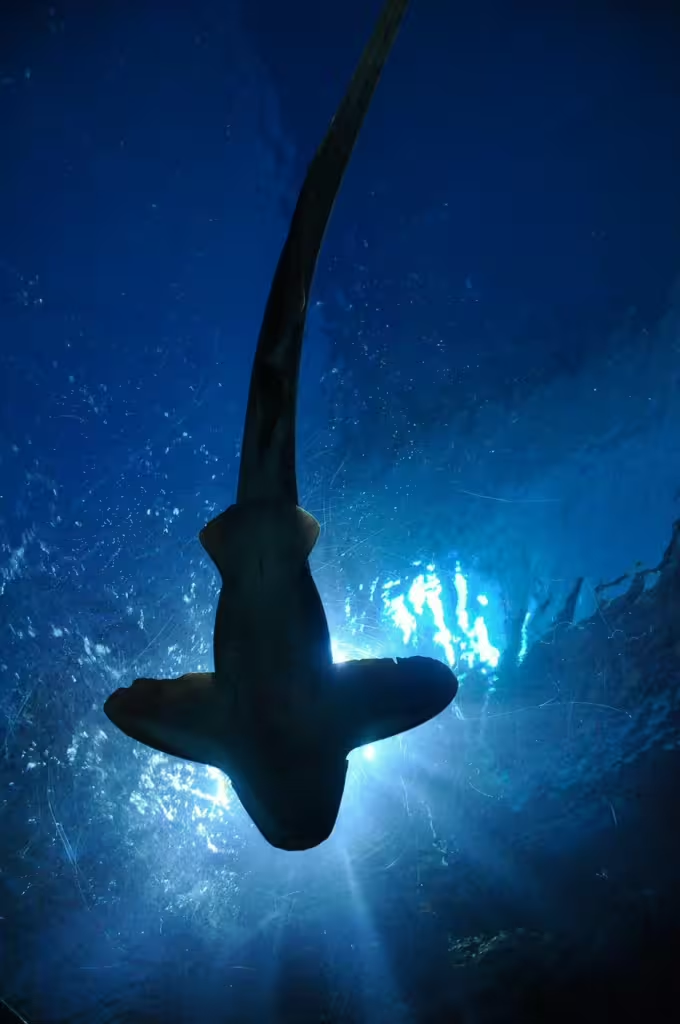
These sharks can be found out in the open ocean, where their speed and iconic off-set tail fins allow them to hunt in a way that no other ocean predator can. If one were to look up from below and see a thresher, they might cut a very unique silhouette.
With a tail that can be as long as its entire body, the thresher shark looks almost exaggerated, as if the tail might be just for mating or show. The truth is that nature’s experimental proportions on this fish were what enabled it to find a new way to hunt.
In this article, we will discuss the unique anatomy of the thresher shark, as well as its key role in marine ecosystems. By the time we’re done, perhaps you too will see how these incredible fish offer humanity a fascinating glimpse into how evolution can shape both form and function.
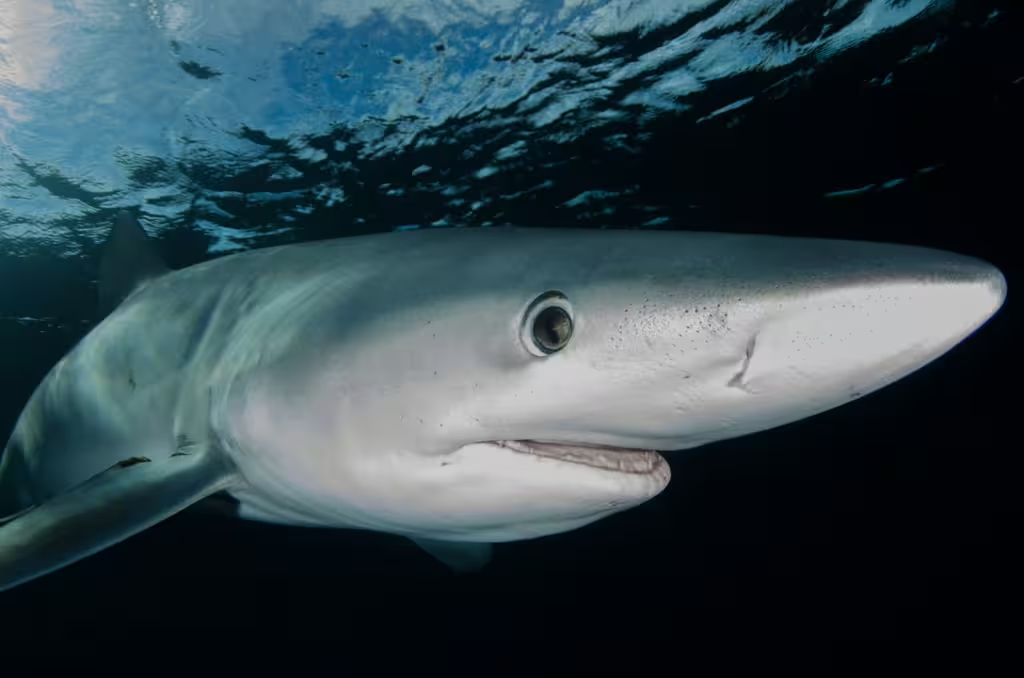
A Shark Like No Other
There are many different species of sharks swimming around out there and most of them don’t feed on human beings; at least not purposely anyway. In fact, there are only about 60 or 70 shark attacks a year across the entire globe, so it’s not like they are hunting humans in any real capacity.
But we digress, among the 500 or so different shark species that we know of, only three are considered the main species of thresher sharks. Thresher sharks include the common Thresher Shark, Bigeye Thresher Shark, and the Pelagic Thresher Shark.
All of these species share the same defining feature: an extraordinarily long upper lobe of the tail, which can make up nearly half of the shark’s total length. Most threshers grow between 10 and 20 feet long, and much of that length comes from their tails. Why do these sharks have such long and lustrous tail fins?
The Tail That Hunts
When it comes to thresher sharks, it’s not about the size of the tail, but how they use it. That is, how well it functions alongside their streamlined bodies. You see, threshers live in the open ocean and their lithe form is designed to match this open environment. But unlike other sharks that rely on speed or stealth to hunt prey, thresher sharks use their tails as a weapon.
When stalking potential prey, a thresher shark will follow this hunting pattern. First, the shark approaches a school of fish. They swim in a tight arc or loop around the school until they find the perfect angle. Then, they snap their tails forward in a powerful whip-like motion. The purpose of this movement is to stun or kill multiple fish at once.
At the same time, the whipping can disrupt the school’s formation, thereby making prey easier for the shark to capture. Most of the time, the force of the tail strike is strong enough to break or injure small fish, or even knock them unconscious.
This effectively means that the shark has a whipping, biomechanical cudgel attached to its body. It is a powerful hunting method allows thresher sharks to capture their chosen prey as efficiently as possible, especially in environments where prey tends to be fastand highly coordinated.
Built for Precision
Using such an effective and physically-attached weapon requires careful control of the shark’s muscles. To this end, thresher sharks have evolved strong muscles to generate force and flexible bodies that allow them to maneuver quickly. They have also evolved and must learn to master precise coordination between movement and timing.
Now, none of this is easy for a fish, mind you, which is why so much of what the shark can do is the result of the adaptive, evolutionary process. And despite what many of you might be thinking, the tail is not simply swung randomly. It is used with accuracy, targeting dense groups of fish. This level of control highlights the complexity of the thresher’s hunting strategy.

Diet and Feeding Behavior
Thresher sharks primarily feed on small schooling fish such as sardines and mackerel, squid, and occasionally other small marine animals that cross their path. Their main hunting process involves schools of fish, however, as disrupting organized fish is kind of what they were literally designed for. Whatever prey they choose to stun, however, they can then eat them at their leisure while the fish convalesces.
Life in the Open Ocean
Thresher sharks are typically found in pelagic zones, or open ocean environments. As such, they prefer deep offshore water where there are abundant fish populations. Any regions with moderate or warm temperatures are perfect for thresher sharks. They are solitary creatures, like most sharks, and don’t really form schools at all. Instead, they gather in areas rich in food.
Role in Marine Ecosystems
As predators, thresher sharks play an important role in maintaining the biological balance in marine ecosystems. Their appetites help regulate fish populations and prevent overpopulation for some key species. As top predators, threshers maintain healthy undersea food webs and their very existence influences how certain fish behave and migrate beneath the waves.
Threats and Conservation
Despite their impressive adaptations for surviging and thriving in deep water ecosystems, thresher sharks face several threats from human beings. Overfishing and bycatch are continous problems for predators like these, who often get caught up in fishing nets as they chase after schools of fish; a product that maritime human communities cannot live without.
At the same time, habitat changes wrought by climate change and rising open temperatures are changing how and where these animals feed. That’s not even counting the tons of pollution they encounter and accidentally ingest in the sea. Because they reproduce slowly, thresher populations have been experiencing steep declines in recent years.
If conservation efforts to mitigate bycatch, regulate the fishing industry, clean up plastic refuse, and protect critical habitats are not carefully managed, these threats could one day spell the end for threshers and their kin.
True Investigator Says…
As you can see, thresher sharks aren’t just the most distinctive predators in the ocean, they are also some of the most well-adapted to the role as apex predator. Visually striking and intense to behold in action, these sharks plat a vital role in balancing marine ecosystems. Their specialized hunting adaptations are just more evidence that nature does not act purely on aesthetics, but designs things with both form and function in mind.
Discover more from TrueInvestigator
Subscribe to get the latest posts sent to your email.