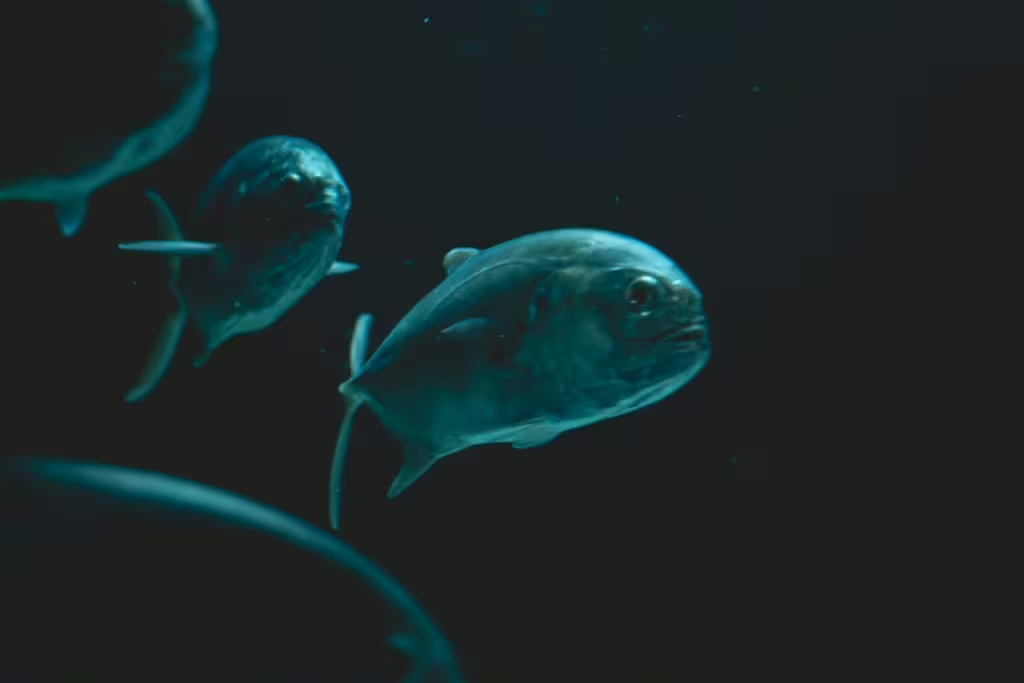

We’ve been here before, though it’s been some time since we traversed this deep beneath the roiling surface of the ocean. Despite everything we know about the nature of nature, the alien world of the deep ocean is one that continues to fascinate humanity even in the modern age. In this realm, sunlight is nothing but a bygone memory; darkness dominates and in that frigid, highly-pressurized environment, only the most extreme lifeforms survive; and most of them…hunt one another.
This unseen gloom is home to some of the most unusual and formidable predators on the entire planet. Many of the creatures living here have evolved extraordinary adaptations to locate, capture, and consume prey. In a place where food and visibility are very limited, the evolutionary traits that enable these frightening creatures to hunt are particularly helpful.
In this article, we will explore the cold and terrible waters of the deepest oceans in search of the most formidable predators that the dark has to offer. We will speak about their ecology, their diets, and somewhat startling adaptations they possess. So put on your scuba gear once more, dear reader, we’re about to take a deeper dive than usual.
Life in the Deep Sea
The term “deep sea” might seem somewhat broad when one thinks about the great scale of the world’s oceans. Fortunately, science has come a long way since the nautical age and so, we can now quantify what we mean when we say deep sea. For our purposes, this term refers to any ocean depths below 200 meters, where sunlight no longer penetrates effectively. This vast region includes a few different aquatic environments such as:
- The mesopelagic zone (twilight zone)
- The bathypelagic zone (midnight zone)
- The abyssal plains
- Deep-sea trenches
In this place, conditions here are challenging for most living things. Not only is the entire zone shrouded in near-total darkness, it is also unbelievable cold, albeit right above freezing. At the same time, the water pressure is too high for many species to survive. All of this is compounded by the fact that food is exceptionally limited. As a result, deep-sea predators must be as energy-efficient as possible. This means that every movement and every hunt has to count.
Bioluminescence: Light in the Darkness
In the endless dark of the abyss, natural bioluminescent adaptations allow animals to stand out, communicate, attract prey, or camouflage themselves. These lights can often mean the difference between life and death. One prime example is the anglerfish, which uses the iconic glowing lure on its head to mimics small prey and draw in curious animals. Once those hungry predators ge close enough, the anglerfish bites.
The Anglerfish: Master of Ambush
There’s a reason why the anglerfish always end up at the top of these lists. Indeed, few deep-sea predators are as iconic as the deep sea anglerfish. With its large head, wide mouth, glowing lure, and sharp teeth, this outstanding animal is easily recognizable. It is also strong and clever enough to consume prey that is nearly as large as itself.
The Gulper Eel: Expanding to Survive
The gulper eel, as the name implies, can also swallow prey that is nearly as large as itself. This fish possesses one of the most unusual feeding strategies in the ocean, namely, a mouth that is enormous relative to its body. That mouth means the gulper eel is not picky, it can gulp up whatever prey it finds and digest them over time, thereby maximizing every rare feeding opportunity it finds. In an environment where meals are infrequent, the ability to consume large prey is a major advantage.
The Fangtooth Fish: Small but Powerful
Not all the predators are the deep are as large or powerful as a Great White Shark. Some are actually quite small. Take the fangtooth fish for example. Tiny though it may be, this sharp-toothed little ichthyoid one of the most intimidating deep-sea predators alive today. It possesses a set of oversized teeth that extend beyond its mouth, giving it a powerful, inescapable bite. It is also a cantankerous little critter that exhibits highly aggressive feeding behavior. When meals are infrequent, it pays to be tenacious and precise about one’s bites.
The Viperfish: Speed and Precision
The viperfish has long, needle-like teeth and a hinged jaw that lets it engulf prey much larger than one might think. It also has a glow lure along its body to draw in prey and predators alike. When the hapless fish gets too close, it strikes out with remarkable speed, slicing into its prey and swallowing it whole. The eel’s long body is also streamlined to allow it to swim efficiently, thereby conserving energy.
Camouflage in the Dark
In the deep sea, avoiding detection is just as important as finding food. To remain stealthy and still stand out, many predators use counter-illumination, a form of camouflage where they produce light on their undersides to match the faint light from above. This remarkable evolutionary trait actually renders them less visible to prey looking upward.
Pressure and Adaptation
The immense pressure of the deep sea, which is hundreds of times greater than at the surface, presents further challenges for deep-sea creatures. The predators of the depths have adapted by having flexible, softer bodies than their upper-pelagic peers. At the same time, these fish lacking any additional air-filled spaces in their morphology that would otherwise collapse under the extreme pressure. Finally, undersea animals use specialized proteins that function under extreme conditions, thus allowing them to thrive where most organisms could not survive at all.
Changing Oceans and Future Challenges
Sadly, even the deepest part of the oceans are not immune to human impact. These ecosystems are threatened by the same pollution and climate change that affects waters everywhere, but also are endangered by deep-sea mining concerns. These environments have been the same way for millennia, so any changes have a massive cascading effect on every single lifeform living there. This also means that these ecosystems are slow to recover from environmental damage.
True Investigator Says…
As you can see, the deep sea is a place of extremes darkness, crushing pressure, and unexpected scarcity, but it is also a place where adaptation and predatory evolution are on full display. The aquatic hunters that have dominion over this zone are fearsome, yes, but those toothy, terrible features are perfectly attuned so that they can survive in an unforgiving, ever-challenging locale.
And yet, even with all we know about the frightful fish of the deep, there is still much for modern science to discover. Technology and our own scientific understanding of the world continues to expand, allowing us ever more glimpses into this mostly undiscovered abyss. Below the sea, the hunt continues and the hunters continue their shadowy patrol over an alien realm that man has yet to fully comprehend.
Discover more from TrueInvestigator
Subscribe to get the latest posts sent to your email.